

Blog
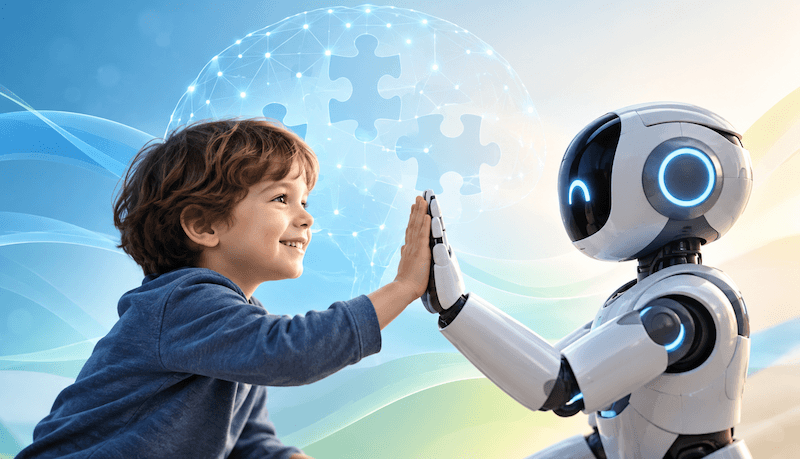
AI in Autism Care: How Artificial Intelligence Is Shaping the Future of Neurodevelopmental Support
Artificial intelligence (AI) is emerging as an important area of research in autism care, with new technologies being explored for assessment, intervention, behavioral monitoring, communication support, and personalized therapy.
A 2026 systematic review published in Frontiers in Psychiatry examined AI-supported therapeutic interventions for autism spectrum disorder (ASD). The review identified applications involving robotics, virtual reality, wearables, machine learning and other AI technologies. While early findings are promising, researchers emphasized the need for larger, better-designed clinical trials and greater representation of adults and females with autism.
How Is AI Being Used in Autism Research?
AI can analyze large amounts of behavioral, speech, movement and physiological data, potentially helping researchers identify patterns that may be difficult to detect through conventional approaches.
Current research is exploring several applications:
1. AI-Assisted Autism Assessment
Machine learning and other AI approaches are being investigated for analyzing behavioral and communication patterns. These technologies may eventually support clinicians by providing additional information during assessment, although they are not a replacement for comprehensive clinical evaluation.
2. Personalized Autism Interventions
One of the most promising areas is personalized intervention. AI systems can potentially adapt activities, difficulty levels and feedback according to an individual's responses.
The 2026 systematic review found evidence that AI-supported interventions may help address social, cognitive and emotional domains, but emphasized that more rigorous research is required before widespread clinical implementation. Frontiers
3. Social Robots and Autism Therapy
Socially assistive robots are being studied as tools for supporting communication, social interaction and therapeutic engagement.
A September 2026 review in the European Journal of Pediatrics examined emerging applications involving social robots, wearable sensors, virtual reality and generative AI. The researchers highlighted the potential of adaptive technologies while also noting that many applications remain under-validated in pediatric populations. Springer
4. Virtual Reality and Immersive Technologies
Virtual reality can provide controlled environments where children and adolescents can practice communication, social interaction and other skills.
When combined with AI, these environments could potentially adapt in real time to individual responses. However, researchers continue to investigate appropriate exposure levels, developmental safety and whether improvements in digital environments transfer effectively to real-world interactions. Springer
5. Wearables and Behavioral Monitoring
Wearable devices can collect information about movement, physiological responses and other behavioral indicators. AI can then analyze these data to identify patterns and potentially support personalized interventions.
This area could contribute to more continuous monitoring, but it also raises important questions regarding privacy, consent, data security and appropriate use of children's health information.
The Importance of Human-Centered Autism Care
Despite rapid technological development, AI should be viewed as a supportive tool rather than a replacement for clinicians, therapists, educators, families or human interaction.
Researchers are particularly focused on ensuring that AI technologies are clinically validated, developmentally appropriate, inclusive and safe. Current evidence remains limited by small study populations, methodological differences and insufficient long-term research.
The future of AI in autism care is therefore likely to depend not simply on developing more sophisticated algorithms, but on demonstrating that these technologies provide meaningful benefits in real-world clinical and educational settings.
What Comes Next?
The intersection of AI, autism, neurodevelopment and mental health is likely to remain an important area of research over the coming years.
Future developments may include:
- AI-assisted behavioral and communication analysis
- Personalized digital interventions
- Social robotics
- AI-powered virtual and augmented reality
- Wearable-based monitoring
- Generative AI for communication and educational support
- Multimodal clinical decision-support systems
- Greater integration of digital tools into multidisciplinary care
However, larger clinical trials, standardized outcome measures, stronger privacy frameworks and inclusive research populations will be essential before these technologies can become routine components of autism care.
Looking Ahead
AI is creating new possibilities for understanding and supporting people with autism, but the field is still developing. The strongest future models are likely to combine technology with human expertise, creating personalized, evidence-based and patient-centered approaches to neurodevelopmental care.
The continuing dialogue between clinicians, researchers, psychologists, psychiatrists, therapists, technology developers and families will be essential to ensure that innovation translates into meaningful improvements in autism and mental healthcare.
Source: Frontiers in Psychiatry (2026); European Journal of Pediatrics (2026).