

Blog
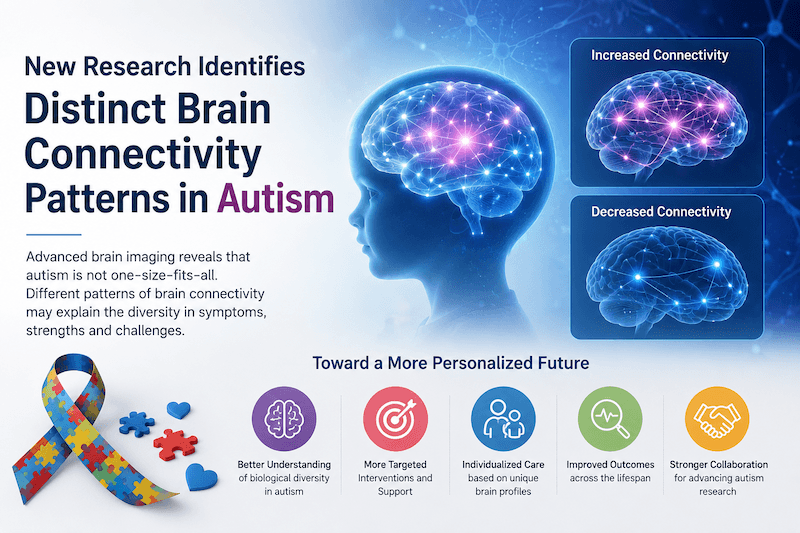
New Research Identifies Distinct Brain Connectivity Patterns in Autism
Autism Spectrum Disorder (ASD) is one of the most complex neurodevelopmental conditions, affecting millions of individuals worldwide. While autism is commonly diagnosed based on behavioural characteristics and developmental patterns, researchers have long recognized that autism is highly diverse, with individuals experiencing different symptoms, strengths, and challenges.
A recent international study has provided new insights into this diversity by identifying distinct patterns of brain connectivity that may represent different biological forms of autism. These findings could contribute to a deeper understanding of autism and support the development of more personalized approaches to diagnosis, intervention, and long-term care.
Understanding Brain Connectivity in Autism
The human brain functions through a vast network of interconnected regions that continuously exchange information. These communication pathways, often referred to as brain connectivity networks, play an essential role in learning, behaviour, communication, sensory processing, and social interaction.
Using advanced functional magnetic resonance imaging (fMRI) techniques, researchers examined brain connectivity patterns among hundreds of individuals diagnosed with autism and compared them with neurotypical individuals. Their analysis revealed two notable patterns of neural communication.
One group demonstrated increased communication between certain brain regions, while another exhibited reduced communication across those same networks. These findings suggest that autism may involve multiple biological mechanisms rather than a single underlying neurological profile.
The Importance of Biological Diversity in Autism
Autism has traditionally been viewed as a spectrum condition because individuals can present with varying levels of support needs, communication abilities, cognitive profiles, and behavioural characteristics. The discovery of distinct brain connectivity patterns further reinforces the understanding that autism is not a single condition with identical biological origins.
Researchers believe that different neurological pathways may contribute to the diverse experiences observed among autistic individuals. Recognizing these biological differences could help explain why interventions that are effective for one individual may not produce the same outcomes for another.
Potential Implications for Personalized Care
One of the most promising aspects of this research is its potential contribution to personalized healthcare. As scientists continue to uncover the biological factors associated with autism, future diagnostic and intervention strategies may become increasingly individualized.
Potential benefits may include:
- Earlier identification of specific autism profiles
- More targeted intervention planning
- Improved understanding of developmental trajectories
- Enhanced support for co-occurring conditions
- Greater precision in future therapeutic approaches
While additional research is required before these findings can be translated into clinical practice, the study highlights the growing movement toward precision medicine in neurodevelopmental and mental health conditions.
Advancing Autism Research Through Collaboration
The study also demonstrates the value of international scientific collaboration. By combining expertise in neuroscience, genetics, neuroimaging, and developmental psychology, researchers were able to examine autism from multiple perspectives and generate insights that may not have been possible through isolated investigations.
Continued collaboration among clinicians, researchers, educators, healthcare professionals, and autistic individuals themselves remains essential for advancing knowledge and improving outcomes across the lifespan.
Looking Ahead
Although autism research has advanced significantly over recent decades, many questions remain regarding the biological mechanisms that contribute to the condition's diversity. The identification of distinct brain connectivity patterns represents an important step toward understanding the complexity of autism and the factors that influence individual experiences.
Future studies involving larger populations and additional biological markers may reveal further autism subtypes and contribute to more personalized support strategies. As research continues to evolve, the ultimate goal remains the same: improving quality of life, promoting inclusion, and providing evidence-based care that meets the unique needs of every autistic individual.
Conclusion
The discovery of distinct patterns of brain connectivity offers valuable insight into the biological diversity of autism. While autism remains a spectrum condition characterized by considerable individual variation, advances in neuroscience are helping researchers better understand the mechanisms underlying that diversity.
As the field moves toward more personalized approaches to healthcare and intervention, such findings have the potential to transform how autism is understood, assessed, and supported in the years ahead.
Source: Istituto Italiano di Tecnologia - IIT
ImageCredits: Freepik